PVD / Ion Plating for Stainless Steel Jewelry: A Technical Guide
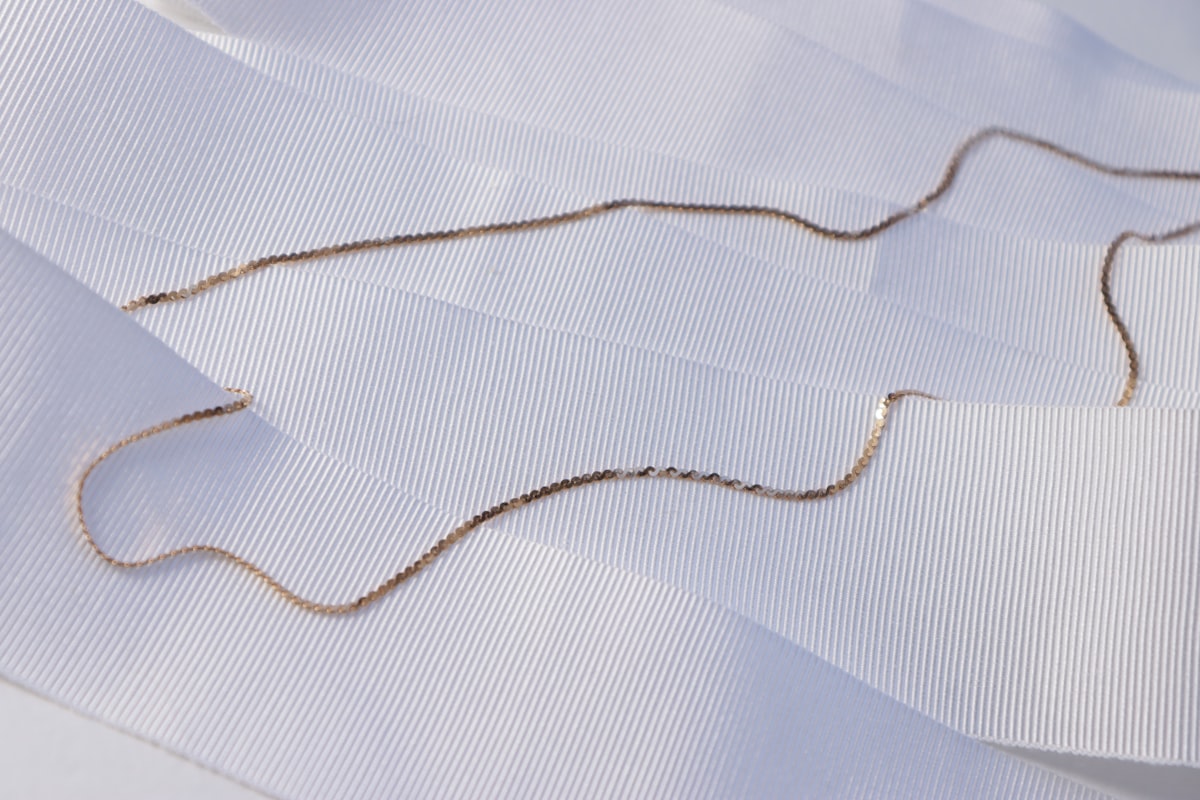
Physical vapour deposition, PVD, is the process behind most coloured stainless steel jewelry sold today, and it is described loosely enough in the trade that the word has stopped carrying much information. "Ion plating" appears alongside it, sometimes as a synonym and sometimes as a distinct claim. They are not quite the same thing, and the difference is worth understanding because it is the part of the process that decides how well the colour stays on.
This guide covers what happens inside the chamber, where the colour actually comes from, how the resulting structure differs from electroplating and from gold filled, and which of those differences matter once a piece is on a wrist. It is written as a materials explanation rather than a product pitch, and the thickness and hardness figures cited are published standard values rather than measurements of any particular range.
What physical vapour deposition actually is
PVD is a family of processes with one thing in common: a solid source material is converted into a vapour of individual atoms and ions inside a vacuum chamber, that vapour travels across the chamber, and it condenses atom by atom onto the workpiece. Nothing dissolves, nothing is reduced out of a solution, and no water is involved at any stage. This is the fundamental split from electroplating, which is an aqueous electrochemical process.
The vacuum is not an aesthetic detail. Two things depend on it. First, air must be removed so that oxygen and water vapour do not react with the vapour stream and contaminate the growing film; chambers are typically pumped down into the 10−3 Pa range, around 10−5 mbar, before anything starts. Second, at low pressure the mean free path — the average distance a particle travels before hitting another particle — becomes long compared with the size of the chamber, so vaporised atoms cross to the workpiece in a more or less straight line and arrive with the energy they left with, instead of being scattered and slowed by collisions with air.
Getting the metal into the vapour phase
Two source methods dominate decorative jewelry coating, and they behave differently enough that it is worth knowing which one a coater runs.
- Cathodic arc evaporation. A high-current, low-voltage arc is struck on the surface of a solid target. It concentrates into microscopic spots that move rapidly across the target face, and the enormous local power density at each spot vaporises and ionises the metal directly. The distinguishing feature is that a very high fraction of the resulting vapour is ionised rather than neutral, which is what makes arc sources so well suited to ion plating. The cost is that the same violent local melting throws off micron-scale molten droplets, called macroparticles, which land on the workpiece as surface defects.
- Magnetron sputtering. An inert gas, usually argon, is admitted to bring the chamber up to roughly 0.1–1 Pa and is ionised into a plasma. Argon ions are accelerated into the target, and pure momentum transfer knocks target atoms loose — a mechanical process, not a thermal one. A magnetic field traps electrons in a racetrack close to the target surface, raising the local ionisation rate and with it the deposition rate. Sputtering yields a much smoother, droplet-free film, but a smaller share of the vapour arrives ionised.
Where "ion plating" is a real distinction
Ion plating is not a marketing intensifier for PVD. It has a specific accepted meaning: deposition in which the growing film is simultaneously bombarded by energetic ions, deliberately and continuously, so that the bombardment itself alters how the film forms. The mechanism is a negative electrical bias applied to the workpiece. Because a large share of the arriving vapour is ionised, that bias accelerates ions into the surface rather than letting them settle gently, typically at a few tens to a couple of hundred volts during deposition.
That bombardment does four things that a passive, unbiased deposition does not:
- It cleans in situ. Arriving ions sputter away the last of the adsorbed contaminants and the native oxide film on the steel, so metal is depositing onto metal rather than onto an oxide skin.
- It intermixes the interface. Energetic ions penetrate a few atomic layers and knock substrate atoms around, so instead of a flat boundary between coating and steel there is a graded zone tens of atoms deep where the two compositions blend. This is the single most important reason ion-plated coatings adhere the way they do.
- It densifies the film. Films grown without bombardment tend to form loose columnar grains with voided boundaries between them. Bombardment gives arriving atoms enough surface mobility to fill those voids, producing a denser structure with fewer through-paths.
- It puts the film into compression. Implanted ions leave the coating in a state of residual compressive stress, which makes it harder for a surface crack to open and propagate.
The step most descriptions skip
Before any coating is laid down, a properly run cycle performs an ion etch: the parts are held at a much higher negative bias, often several hundred volts, in an argon plasma with no deposition happening. The workpiece is being sputter-cleaned by the plasma — atoms are being removed from it, not added. This strips the passive chromium oxide layer and any residual polishing compound, and it is what leaves an atomically clean surface for the intermixed interface to form on.
This is also why adhesion failures in decorative PVD are usually traceable to preparation rather than to the coating recipe. A film deposited over a contaminated or incompletely etched surface can look perfect leaving the chamber and lift in service, because the bond it needed was never formed.
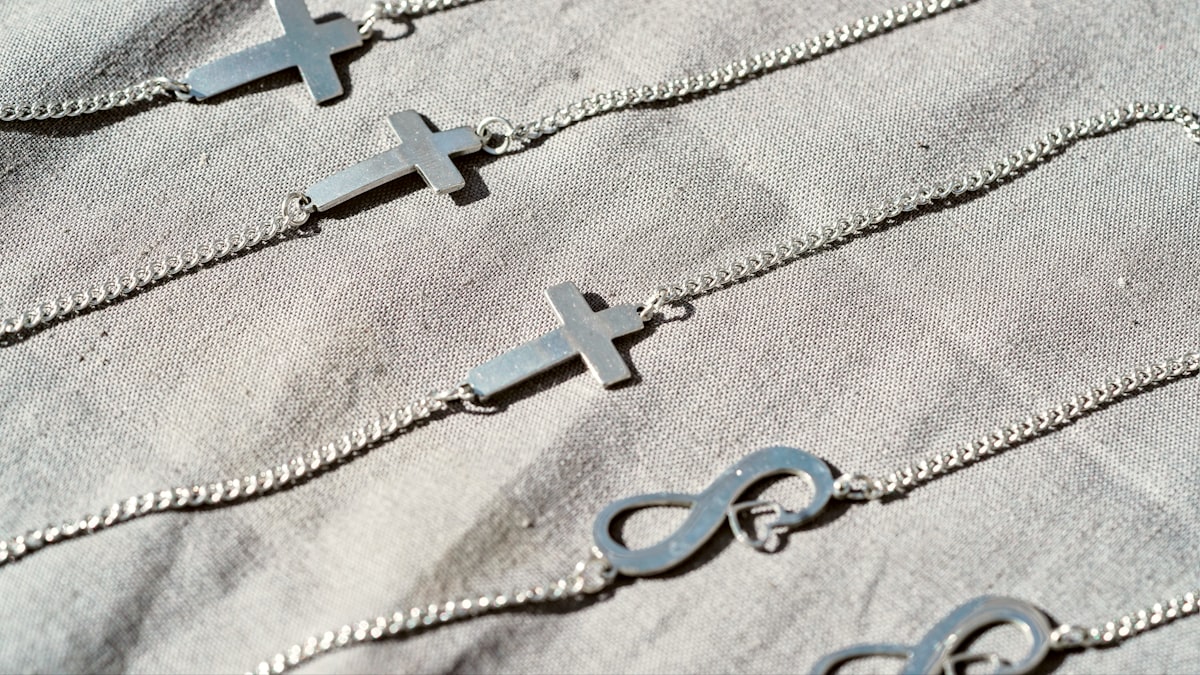
Where the colour comes from
The most common misunderstanding about PVD is that the colour is applied, as a pigment or a dye would be. It is not. In reactive deposition, a reactive gas is admitted to the chamber during coating and combines with the metal vapour at the workpiece surface, so the film that grows is a compound the chamber synthesised in place. Admit nitrogen with a titanium vapour and the film that forms is titanium nitride.
Titanium nitride is gold-coloured for the same reason gold is: its electronic band structure absorbs in the blue and violet part of the spectrum and reflects strongly in the yellow and red. The colour is an intrinsic optical property of the compound, which is why it goes all the way through the layer instead of sitting on top of it, and why it cannot fade in the way an organic coating fades under light. Changing the metal or the reactive gas changes the compound and therefore the tone.
| Coating compound | Typical appearance | How it is produced |
|---|---|---|
| Titanium nitride (TiN) | Warm yellow gold | Titanium source, nitrogen as the reactive gas |
| Zirconium nitride (ZrN) | Paler, brassier gold | Zirconium source, nitrogen as the reactive gas |
| Titanium carbonitride (TiCN) | Bronze through rose and pink-grey, depending on the carbon share | Titanium source with both nitrogen and a carbon-bearing gas |
| Chromium nitride (CrN) | Bright silver-grey | Chromium source, nitrogen as the reactive gas |
| Titanium aluminium nitride (TiAlN) | Dark grey to near-black | Mixed titanium-aluminium source, nitrogen as the reactive gas |
| Diamond-like carbon (DLC) | Deep black, low gloss | Carbon-based film, generally deposited by a related plasma-assisted process rather than a straight metal-vapour one |
Within any one of these, the exact shade is tuned by the gas flow, the chamber pressure and the bias, which is why nominally identical gold-tone PVD from two different coaters can differ visibly. There is a second route as well: some jewelry PVD uses a genuine gold or gold-alloy target to deposit actual gold rather than a nitride. That produces a truer precious-metal tone but gives up the hardness that makes nitride coatings interesting in the first place, so both routes exist in the trade and the word "PVD" on a listing does not tell you which one was used.
PVD, electroplating and gold filled are three different structures
These three constructions are routinely presented as a quality ladder. They are better understood as three different physical arrangements of metal, each of which fails in its own characteristic way.
| PVD / ion plating | Conventional electroplating | Gold filled | |
|---|---|---|---|
| How the layer is formed | Vapour condenses atom by atom in vacuum; the coating compound is synthesised at the surface | Metal ions in an aqueous bath are reduced onto the part by an electric current | A sheet of karat gold alloy is mechanically bonded to a base-metal core with heat and pressure, then drawn or rolled to size |
| What holds it on | An intermixed, graded interface a few tens of atoms deep, created by ion bombardment | Adhesion at a comparatively abrupt interface, dependent almost entirely on how well the substrate was cleaned and activated | A metallurgical bond formed under pressure across the full interface |
| What the layer is made of | Usually a hard ceramic nitride; sometimes gold or a gold alloy | Soft metallic gold or a gold alloy | Karat gold alloy, identical in kind to solid gold |
| Order-of-magnitude thickness | Sub-micron: decorative coatings are conventionally in the region of a quarter of a micron up to about one micron | Anywhere from a fraction of that upward; the United States FTC Jewelry Guides set 0.175 µm as the floor for "gold electroplate" and 2.5 µm for "heavy gold electroplate" | Defined by weight rather than by depth: the karat gold layer must be at least one twentieth of the item's total weight, which puts it orders of magnitude above any coating |
| How it behaves as it wears | Hard and abrasion-resistant, but brittle; wears through at high points rather than thinning evenly | Soft; abrades and burnishes away progressively, fastest at edges and contact points | Thick enough that ordinary wear takes years to reach the core; behaves like gold because it is gold |
Read across the "what holds it on" row and the practical difference emerges. Electroplating relies on adhesion at a boundary; PVD replaces the boundary itself with a mixed zone. That is a structural distinction, not a matter of degree, and it explains why well-executed PVD does not flake in sheets the way a poorly prepared plated layer can.
Hardness explains more of the outcome than thickness does
Decorative finishes are almost never lost to corrosion. They are lost to abrasion: a ring shank against a desk, a chain against a collar, a bracelet against a keyboard. What resists abrasion is hardness, and this is where the nitride coatings separate themselves from plated gold by a wide margin.
| Material | Typical published hardness (Vickers) |
|---|---|
| Titanium nitride coating | Approximately 2,000–2,500 HV |
| Annealed 304 / 316L stainless steel | Approximately 180–220 HV |
| Hardened (cobalt-alloyed) gold electroplate | Approximately 130–200 HV |
| Soft fine-gold electroplate | Approximately 60–90 HV |
An order of magnitude in hardness is why a sub-micron nitride film can outlast a plated layer several times its depth. It is also why thickness is a poor headline figure on its own: a thick soft layer and a thin hard one are not comparable quantities, and neither number means anything without knowing the interface underneath it.
Hardness cuts both ways, though, and the honest version of this includes the trade-off. Hard ceramic films are brittle. On a substrate soft enough to deform under a sharp impact, the coating cannot follow the deformation and cracks locally — the so-called eggshell effect. This is one reason the substrate matters as much as the coating, and why stainless steel, which is considerably harder than the brass and copper alloys used elsewhere in fashion jewelry, is the base these coatings are best matched to.
On published thickness figures
The sub-micron band quoted above is the conventional range for decorative PVD in general engineering practice. Jewelry-trade coating covers a wider spread than that, at both ends, because decorative runs are tuned for colour and cost rather than to a wear specification. So the useful advice to a buyer is to treat any industry norm as a starting point rather than an assumption, and to ask for the figure from the specific coater and the specific run.
We do not publish a single thickness number across our own range, for the same reason we publish no lifespan figure: it would vary by piece and by finishing run, and a range-wide number is not something anyone could hold us to per SKU. A figure that cannot be tied to the item in front of you is decoration on a specification sheet, not information.
Corrosion: the coating is not the barrier
This is the part most often stated backwards. A decorative coating is not what keeps a piece of jewelry from corroding. The base metal is, and the coating can make the situation worse rather than better if the base is wrong.
No sub-micron film deposited on a complex three-dimensional shape is perfectly continuous. Arc-source coatings carry macroparticle defects; every process leaves some pinholes, and edges and sharp radii receive thinner coverage than flat faces. So there will be sites where the base metal is exposed to the outside world through the coating.
At those sites an electrochemical problem appears. Titanium nitride and gold are both noble relative to steel, so in the presence of sweat or any other electrolyte, a galvanic couple forms between the exposed base metal and the surrounding coating. The exposed metal is the anode, the coating is the cathode, and the areas are wildly mismatched: a pinhole a few microns across is coupled to a cathode covering the whole piece. Corrosion current concentrates into that tiny anode, so attack at a defect is far more aggressive than it would be on the same metal left bare.
Which base metal sits underneath therefore decides the outcome:
- On stainless steel, the exposed spot repassivates. Chromium in the alloy reforms the protective oxide film in air and in most everyday conditions, so the defect is self-limiting and the piece continues to look like a piece of steel where the colour has worn.
- On brass or copper alloy, there is no such recovery. The exposed metal corrodes, the products creep outward under the coating edge and undermine it, and the visible failure spreads well beyond the original defect — which is where the familiar green marking and dark patching around worn spots comes from.
Within stainless steels the same logic favours the more corrosion-resistant grade, since chloride from sweat and seawater is exactly what attacks the passive layer at a defect site. The comparison of grades is set out in our guide to 316L versus 304 stainless steel. The general point stands on its own: a coating claim without a base-metal claim is an incomplete specification, and the base metal is the half that determines what happens after the coating is compromised.
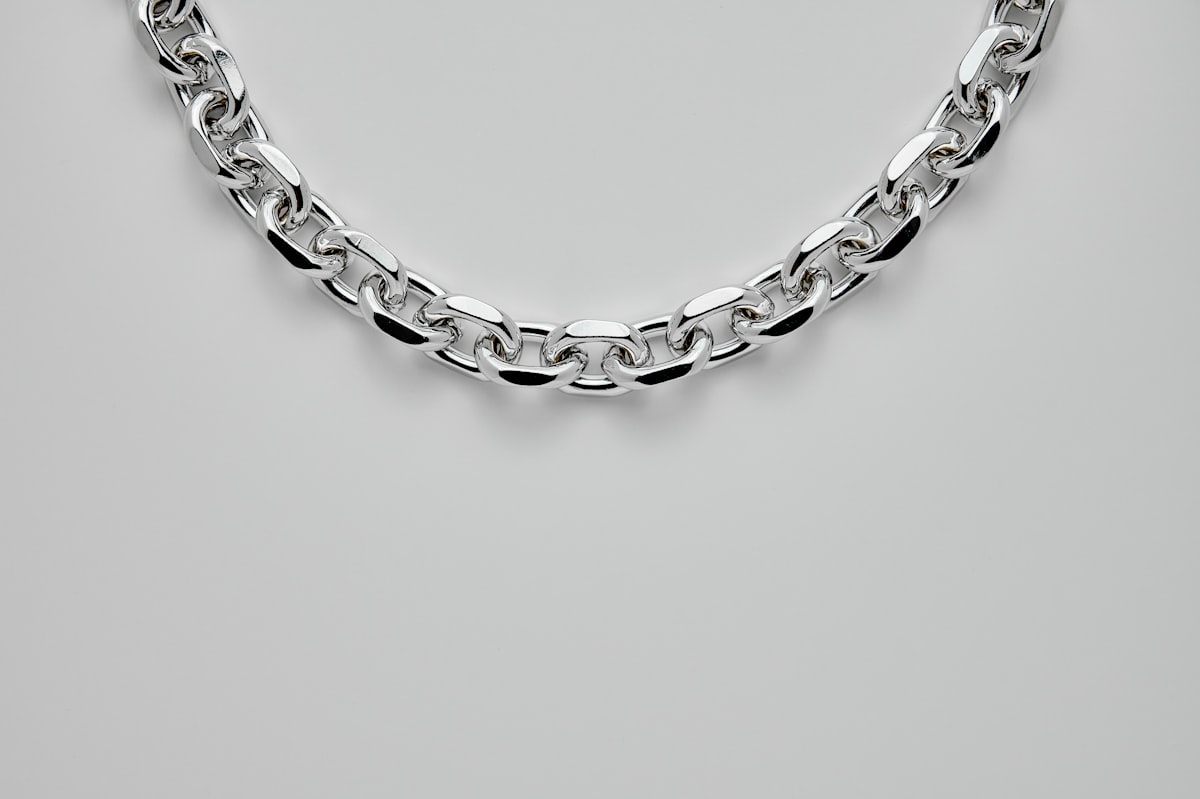
What jewelry geometry does to the process
Most published PVD data describes flat tooling and simple parts. Jewelry is neither, and three consequences follow directly from the physics.
Deposition is line of sight. Vapour travels in straight lines from source to workpiece, so a surface that cannot see the source does not get coated. Production chambers address this with planetary fixturing that rotates parts about two or three axes as the cycle runs, sweeping every outer face through the vapour stream. Genuinely enclosed geometry still loses out: the interior of a lobster clasp, the inner face of a tight link, the recesses of a deeply textured casting. On a fine chain, coverage is a fixturing question as much as a recipe question.
The coating replicates the surface it is given. A film a fraction of a micron deep cannot level anything. Electroplating baths can be formulated with brighteners that partly smooth a mediocre surface; PVD has no equivalent, and reproduces every scratch, drag line and polishing mark faithfully. All polishing must therefore be finished before the parts are loaded, and quality in a PVD piece is largely decided before the chamber is ever closed.
Wear is concentrated, not uniform. Because the film is hard, it does not thin gradually across a whole surface the way a soft plated layer does. It survives intact where it is not touched and goes through where it is: the underside of a ring shank, the outer curve of a bangle, the wear faces of clasp mechanisms. The practical implication for a range is that piece type predicts finish life far better than any coating figure does — the mechanisms behind that are covered in our guide to how long PVD gold plating lasts.
How to read a PVD claim on a specification
"PVD" on its own describes a family of processes, not a specification. Most PVD coating jewelry listings stop at the three letters, which is why the same word ends up covering finishes that behave very differently in wear. Four questions turn it into something checkable.
- What is the base metal, by grade? This is the first question, not the last, because it determines what happens once the coating is breached. A PVD claim over an unnamed base metal has left out the important half.
- Is the colour a nitride or a deposited gold alloy? The two behave differently under abrasion, and both are legitimately called PVD.
- Is the workpiece biased during deposition? This is what separates ion plating from a passive vapour deposition, and it is the mechanism behind the adhesion the process is bought for.
- Is the claim made per SKU or for the range? Finishing is decided per production run. A finish claim attached to a catalogue rather than to an item is not something anyone can be held to.
The same discipline applies in reverse when writing your own listings. Describe the construction rather than its future: "gold PVD coating on 316 stainless steel" is defensible; "never fades" and "lifetime gold" are not. And keep karat numbers in their lane — when a coating is described as 18K gold PVD, the karat figure is a colour reference for the tone the coating reproduces, not a statement of gold content. Our comparison of gold plated, PVD, vermeil and solid gold covers the commercial side of that distinction in more detail.
FAQ
Is ion plating the same as PVD?
Not exactly. PVD is the umbrella term for any process that vaporises a solid source in vacuum and condenses it onto a workpiece. Ion plating is a specific variant in which the workpiece is held at a negative electrical bias so the growing film is continuously bombarded by energetic ions. All ion plating is PVD; not all PVD is ion plating. The bombardment is what cleans the surface in place, blends the interface between coating and substrate, and densifies the film, so it is the part of the process that adhesion depends on.
Why is PVD gold coating gold-coloured if there is no gold in it?
Because titanium nitride, the compound most often used for a gold tone, is intrinsically gold-coloured. Its electronic band structure absorbs blue and violet wavelengths and reflects yellow and red, the same optical behaviour that makes metallic gold look the way it does. The colour is a property of the compound throughout its depth rather than a pigment applied to the surface. Some jewelry PVD does deposit real gold or a gold alloy instead, which gives a truer precious-metal tone but a much softer film.
Is PVD more durable than gold plating?
Under abrasion, generally yes, and for two structural reasons rather than one. Nitride coatings are roughly an order of magnitude harder than plated gold on the Vickers scale, and ion bombardment during deposition creates a graded, intermixed interface instead of the abrupt boundary an electroplated layer relies on. Neither makes a coating permanent. Hard films are also brittle, so they can crack under sharp impact on a soft substrate, and they wear through at high-contact points rather than thinning evenly.
Does PVD coating stop stainless steel from corroding?
No, and expecting it to is the wrong model. Corrosion resistance comes from the base metal, whose chromium content forms a self-repairing passive oxide layer. A sub-micron coating on a complex shape always has some pinholes and thin spots, and because the coating is noble relative to steel, corrosion current concentrates at those defects. On stainless steel the exposed spot repassivates and the damage stays local; on a brass or copper base it does not, and corrosion spreads underneath the coating. The coating supplies colour and abrasion resistance; the base metal supplies corrosion resistance.
How thick is PVD coating on jewelry?
Decorative PVD in general engineering practice is conventionally in the sub-micron range, roughly a quarter of a micron to about one micron, against a floor of 0.175 µm that the FTC Jewelry Guides set for anything described as gold electroplate. Jewelry-trade coating spreads wider than the engineering norm at both ends, because decorative runs are tuned for colour and cost rather than to a wear specification. Thickness is also a weaker predictor of outcome than hardness and interface quality, so a specific figure from the specific coater and run is worth more than any industry range.
Can PVD be applied over brass or plated jewelry?
Physically yes, and it is done. The result behaves differently, though, because the base metal decides what happens after the coating is breached. Brass and copper alloys do not repassivate, so corrosion at a pinhole undermines the coating edge and spreads. Those alloys are also softer than stainless steel, which makes a hard brittle film more likely to crack under impact. This is why PVD and stainless steel are so often paired: the substrate is hard enough to support the film and self-healing enough to contain a defect.
Why does PVD jewelry need to be polished before coating?
Because a film that thin cannot level a surface. Electroplating baths can be formulated with brightening additives that partly smooth an imperfect substrate; PVD has no equivalent mechanism and reproduces the underlying topography exactly, scratches included. Every polishing and finishing operation therefore has to be complete before the parts are loaded, and the cleanliness of that finished surface also determines whether the ion etch can produce a properly bonded interface.
Is "PVD plated" a meaningful specification on its own?
No. PVD plated names a family of vacuum processes and nothing else — not the base metal, not whether the colour is a nitride or a deposited gold alloy, not whether the workpiece was biased during deposition, and not whether the claim was made for the item or for the catalogue. Two pieces both honestly described as PVD plated can differ more from each other than one of them differs from a well-executed electroplated finish. Treat the phrase as the start of the specification rather than the end of it: ask for the base metal by grade first, because that is what decides the outcome once the coating is breached, and ask whether the process is recorded against the item number or asserted across a range.
Bottom line
PVD is worth understanding at this level of detail because almost everything that decides how a coloured stainless steel piece ages is invisible on the finished item. The colour comes from a compound synthesised in the chamber, the adhesion comes from ion bombardment blending the interface rather than from any bond at a boundary, the abrasion resistance comes from hardness rather than depth, and the corrosion resistance does not come from the coating at all — it comes from the steel underneath. A specification that names the process without naming the base metal has described the visible half and omitted the half that matters after the first year.
Jewena is a factory-direct B2B wholesale platform for stainless steel jewelry. We run our own dedicated production lines with long-term partner factories in the Dongguan and Foshan clusters of Guangdong, hold ready stock in Guangzhou, and state the finish and the base metal per SKU rather than per catalogue. Gold-tone PVD coated stainless steel jewelry, with USD wholesale pricing and no minimum order, is listed on the gold PVD jewelry wholesale page; 316L is a material we produce to order under a written specification rather than one we sell from stock.