Stainless Steel vs Titanium vs Sterling Silver Jewelry: a Stocking Comparison for Retailers
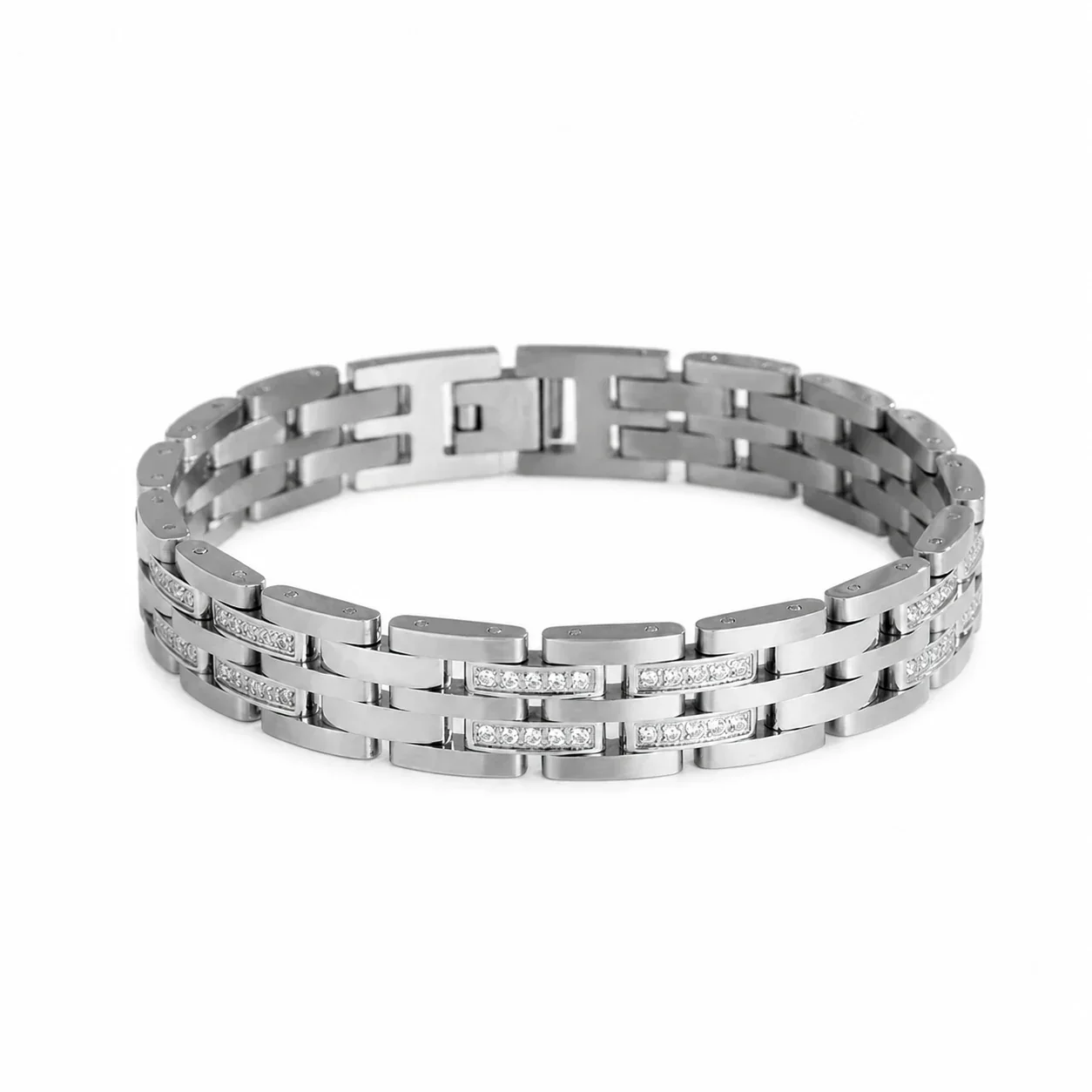
None of the three is the best metal for jewelry, and a range that stocks only one of them is leaving customers unserved. Stainless steel gives the widest choice of designs and finishes at the most stable cost, does not tarnish in ordinary wear, and contains nickel. Titanium is a little over 40% lighter than steel, does not tarnish either, and in its common jewelry and implant forms contains no nickel — but it is harder to work, so designs are simpler and prices sit higher. Sterling silver is the only precious metal of the three: brightest white, repairable, resizable, priced against the silver market, and it tarnishes.
That paragraph is the short answer. The rest of this guide is written for retailers, resellers and independent brands deciding what to actually put on a shelf: how each metal feels in the hand, how each behaves over a year of wear, what the sensitive-skin position honestly is for each, why their price bands move for different reasons, and how to combine them by customer segment rather than picking a winner. Jewena is a factory-direct B2B wholesale platform selling stainless steel jewelry produced in Guangdong with long-term partner factories in the Dongguan and Foshan jewelry clusters — we stock one of these three metals, and this guide says where the other two are the better answer.
What each metal actually is
Stainless steel
An alloy of iron and chromium, with nickel added in the austenitic grades used for jewelry, of which 304, 316 and 316L are the ones you will see quoted. The chromium forms a thin, self-repairing oxide film across the surface, and that passive layer is what makes the material corrosion-resistant. The differences between the jewelry grades are real but narrower than marketing suggests; our 316L versus 304 comparison and what 316L means on jewelry cover that ground.
Titanium
An element rather than a mixture, though jewelry uses both commercially pure titanium and alloys such as the aluminium-vanadium grade widely used in implants. Titanium forms its own protective oxide film, which is why it resists corrosion so well and why it can be coloured by anodising — the colour comes from light interference in that oxide layer rather than from a coating laid on top.
Sterling silver
92.5% silver with the balance usually copper, which is what the 925 mark denotes. The copper is there for hardness, because fine silver is too soft for most jewelry, and it is also the reason sterling behaves the way it does chemically. Sterling is a precious metal with hallmarking conventions in several markets, and that status carries commercial weight independent of any technical property.
The three side by side
| Stainless steel | Titanium | Sterling silver | |
|---|---|---|---|
| Weight and feel | Substantial. About 7.9–8.0 g/cm³, so a wide cuff or heavy chain has real presence | Notably light. About 4.5 g/cm³, a little over 40% lighter than steel at the same size | Heaviest of the three. About 10.4 g/cm³, the dense feel customers associate with fine jewelry |
| Tarnish behaviour | Does not tarnish in ordinary wear; can dull or scratch. Colour finishes behave per the coating, not the base | Does not tarnish; extremely corrosion-resistant. Anodised colour can wear at abrasion points | Tarnishes to yellow, brown then black as silver sulfide forms. Removable with cleaning; returns over time |
| Sensitive skin | Contains nickel as an alloying element; release rate, not content, is what regulators measure | Pure and common implant alloys contain no nickel, which is why it is a frequent choice for piercings | Silver allergy is uncommon; reactions to the copper content, to solder or to plating do occur |
| What drives the price | Design, finish and labour; the raw metal is a small share of cost | Raw material cost plus difficult machining; fewer factories, narrower style range | The silver spot market, so the cost floor moves and heavier pieces cost proportionally more |
| Repair and resize | Limited; usually replaced rather than repaired | Very limited; conventional soldering and resizing are impractical | Straightforward for a bench jeweller; resizing and repair are normal service |
| Design range available | Widest: chains, settings, plating, PVD colour, textures, stone work | Narrow: mostly bands, simple forms, men's and piercing lines | Broad, with a long tradition of stone setting and detailed work |
| Fits best | Everyday ranges, colour-led fashion lines, volume basics, gifting | Lightweight statement pieces, piercing-adjacent lines, wearers avoiding nickel | Higher price points, keepsake and milestone pieces, ranges needing a precious-metal story |
Weight is the difference customers notice first
The density figures above are not trivia; they are the property a customer reacts to within two seconds of picking a piece up. Sterling silver at roughly 10.4 g/cm³ feels dense and expensive, which is part of why it carries a higher price comfortably. Stainless steel at around 7.9 g/cm³ feels solid without feeling heavy. Titanium at about 4.5 g/cm³ is so light that first-time wearers sometimes read it as hollow or as plastic until they are told what it is.
That has direct stocking consequences. Large hoops, wide cuffs and chunky chains are where titanium's lightness turns into a genuine selling point, because the same design in silver may be uncomfortable to wear all day and expensive to make. Conversely, a small pendant in titanium loses the advantage — there was no weight problem to solve. Steel sits in the middle and is the reason it dominates everyday ranges: heavy enough to feel real, light enough to wear.
Tarnish, and why it is a maintenance property rather than a fault
Steel and titanium both protect themselves with an oxide film and neither tarnishes in normal wear. Sterling silver does tarnish, because silver reacts with sulphur compounds in air, in cosmetics and in some foods to form silver sulfide on the surface. This is not a defect and not a sign of low quality — it is what silver does, it has done it for as long as people have worn it, and it comes off with a polishing cloth or a silver dip.
The commercial question is who does the maintaining. A customer who enjoys caring for silver treats tarnish as normal. A customer who buys a piece to wear daily without thinking about it will treat the same tarnish as a fault and write a review saying so. Retailers reduce that mismatch with anti-tarnish packaging, a care card in the box, and honest wording at the point of sale rather than by avoiding silver. Our jewelry care page covers the routine, and stainless steel versus sterling silver goes deeper on that particular pairing for customers deciding between the two.
One caveat that applies to steel and titanium equally: any colour finish is a separate wear surface with its own lifespan. A gold-toned coating on a steel base and an anodised colour on titanium both change over time, and neither the corrosion resistance of the base nor the colour of the surface predicts the other. Judge a colour finish on a worn sample, per SKU, not on the base metal's reputation.
The sensitive-skin question, answered honestly
"Hypoallergenic" is a marketing description, not a regulated standard, and no metal is allergy-proof for every wearer. Individual sensitivities vary, some people react to materials that almost nobody else reacts to, and any supplier claiming a whole catalogue is safe for everyone is overstating the case. With that framing, the three metals do differ in ways worth knowing.
Nickel is the most common contact allergen in jewelry. Austenitic stainless steel contains nickel as an alloying element, so "nickel-free stainless steel" is not a real category. The nickel is bound within the alloy, and what matters for skin contact is how much is released over time rather than how much is present — which is why the EU regulates nickel release rates for items in prolonged skin contact rather than nickel content. In practice this is why 316 and 316L are the grades usually specified for pieces worn against skin.
Titanium's advantage here is genuine and it is a compositional one: commercially pure titanium and the common aluminium-vanadium implant alloy contain no nickel at all, which is why titanium is so often specified for fresh piercings and for wearers with a diagnosed nickel allergy. The honest caveat is that "titanium" on a label is not automatically a nickel-free guarantee either — nickel-titanium alloys exist and are widely used in other industries — so the grade matters on titanium exactly as it does on steel.
Sterling silver rarely causes a silver allergy, but a sterling piece is not pure silver: the copper content, any solder used at joints, and any surface plating are all possible triggers, and copper can also leave green marks on skin through an unrelated chemical route. Our guide to why some jewelry turns skin green separates that mechanism from allergy, since customers routinely report them as the same thing.
For anything you sell, the defensible position is the narrow one: state the material per SKU, describe what the grade evidence is, and let a customer with a diagnosed allergy make the decision. Our earrings page for sensitive skin sets out that position for our own range, including what we will not claim.
Why the price bands move for different reasons
Comparing the three on price is misleading unless you know what is driving each one, because the cost structures are not the same shape.
With stainless steel, the raw metal is a small share of the finished cost. What you are paying for is design, tooling, finishing, plating and labour, which is why a plain steel band and an elaborate pavé-set steel bracelet can sit several multiples apart. It also means steel prices are stable across a season: nothing in the cost base swings with a commodity market.
With titanium, the raw material costs more and, more importantly, it is difficult to machine. It work-hardens, it galls against tooling, it is not straightforwardly cast or soldered by conventional bench methods, and fewer factories are set up for it. The result is a narrower catalogue of simpler forms at a higher price, and lead times that behave differently from steel.
With sterling silver, the metal itself is a meaningful share of the cost, so the floor moves with the silver market and a heavier piece costs proportionally more to make. That cuts both ways commercially: your margin planning has to absorb a moving input cost, but the precious-metal status supports a higher retail price and gives the piece an intrinsic-value story that neither steel nor titanium can borrow. If you are working out how these translate into shelf prices, our guide to jewelry pricing and margin for resale covers the arithmetic.
Building a mixed range instead of picking a winner
The practical version of this comparison is an assortment question. Most ranges that work are built from more than one metal, with each one carrying the job it is actually good at.
- Everyday and entry tier — stainless steel. The widest design choice, colour finishes, stable costs and no tarnish maintenance. This is where you can carry breadth without tying up capital in metal value, and where trend-led pieces can be replaced each season without regret.
- Mid tier — heavier steel or sterling silver. Either a more substantial steel piece with better finishing, or sterling where the customer is paying partly for the material itself. Silver earns its place when the purchase has an occasion attached to it.
- Specialist line — titanium. A small, deliberate selection rather than a full range: lightweight statement pieces, men's bands, and the nickel-avoidance customer who currently leaves your shop without buying anything. A handful of SKUs can serve a segment that steel cannot.
- Match the metal to the complaint you actually receive. If returns cluster around tarnish, look at steel. If they cluster around weight or skin reactions, look at titanium. If customers say pieces feel insubstantial, silver or heavier steel is the answer rather than a different finish.
- Test with small quantities before committing. A metal that suits your customers on paper can still fail on price positioning in your particular shop. Buy a few pieces, wear them, sell them, then decide.
Where we fit in that picture is narrow and worth saying plainly: our catalogue is stainless steel jewelry, not silver and not titanium. If your range needs a precious-metal tier or a specialist line for customers avoiding nickel, source those elsewhere — steel is not a substitute for either, and we would rather say so than sell you the wrong metal for the job. For the part we do cover, ready stock starts at one piece with unit prices stepping down at three and ten pieces per SKU, prices are published in USD rather than quoted on request, and stock ships from Guangzhou in three to five working days with tracking to more than 60 destinations. Material wording is applied per SKU from the source data for that item, so grade numbers appear only where there is evidence behind them.
If you are building a first order around this, our guide to minimum order quantities explains how to read MOQ structures across suppliers, the wholesale page for boutiques lists current terms, and the 316L stainless steel category shows the SKUs where that grade wording is supported.
FAQ
Is titanium better than stainless steel for jewelry?
Better at some things, worse at others. Titanium is a little over 40% lighter, is highly corrosion-resistant, and in its pure and common implant forms contains no nickel. Stainless steel offers a far wider range of designs, finishes and price points, is easier to manufacture and therefore less expensive to buy, and is available in vastly more styles. For a customer avoiding nickel or wanting a large piece that is comfortable all day, titanium wins. For almost everything else in a general range, steel does.
Which is best for sensitive skin: stainless steel, titanium or sterling silver?
Titanium has the strongest compositional case, because pure titanium and the common implant alloy contain no nickel, the most frequent contact allergen in jewelry. Stainless steel does contain nickel, though it is bound in the alloy and regulated by release rate rather than content. Sterling silver rarely triggers a silver allergy but contains copper and may include solder or plating. No metal is safe for everyone, "hypoallergenic" is a marketing word rather than a legal standard, and a customer with a diagnosed allergy should be given the material information and left to decide.
Does titanium tarnish?
No. Titanium forms a protective oxide film that keeps it stable in ordinary wear, in water and in sweat. Anodised titanium is a different question: the colour comes from that oxide layer and can shift or wear at points of heavy abrasion, so a coloured titanium piece should be judged on how the colour holds rather than on corrosion.
Is stainless steel less expensive than sterling silver?
Usually, and for a structural reason rather than a quality one. Silver is a precious metal priced against a commodity market, so the material is a real share of what a piece costs and the floor moves with the market. In steel the metal is a small share of the cost and the price reflects design and finishing work, which is why steel pieces span such a wide range and why an elaborate steel piece can cost more than a plain silver one.
Can titanium and stainless steel jewelry be resized or repaired?
Rarely, in both cases. Neither takes conventional bench soldering and resizing the way sterling silver does, so a damaged or badly sized piece is usually replaced rather than reworked. This matters most for rings, and it is a good argument for careful sizing guidance at the point of sale — or for stocking sterling in styles where resizing is a normal customer expectation.
Which metal should a new jewelry brand start with?
Stainless steel, in most cases, because it lets you test a wide range of designs at a stable cost without tying capital up in metal value, and because it needs no tarnish maintenance from the customer. Add sterling once you have a price point that supports it and a customer who wants the precious-metal story, and add titanium as a short specialist line when you can name the customer it is for.
Bottom line
Stainless steel, titanium and sterling silver are three different answers to three different customer problems: breadth and durability at a stable cost, lightness and nickel avoidance, and precious-metal status with the maintenance that comes with it. The comparison only becomes useful once you stop asking which metal is best and start asking which customer, at which price point, each one is best for — and then stock accordingly.