Jewelry MOQ Explained: How to Plan a First Wholesale Order
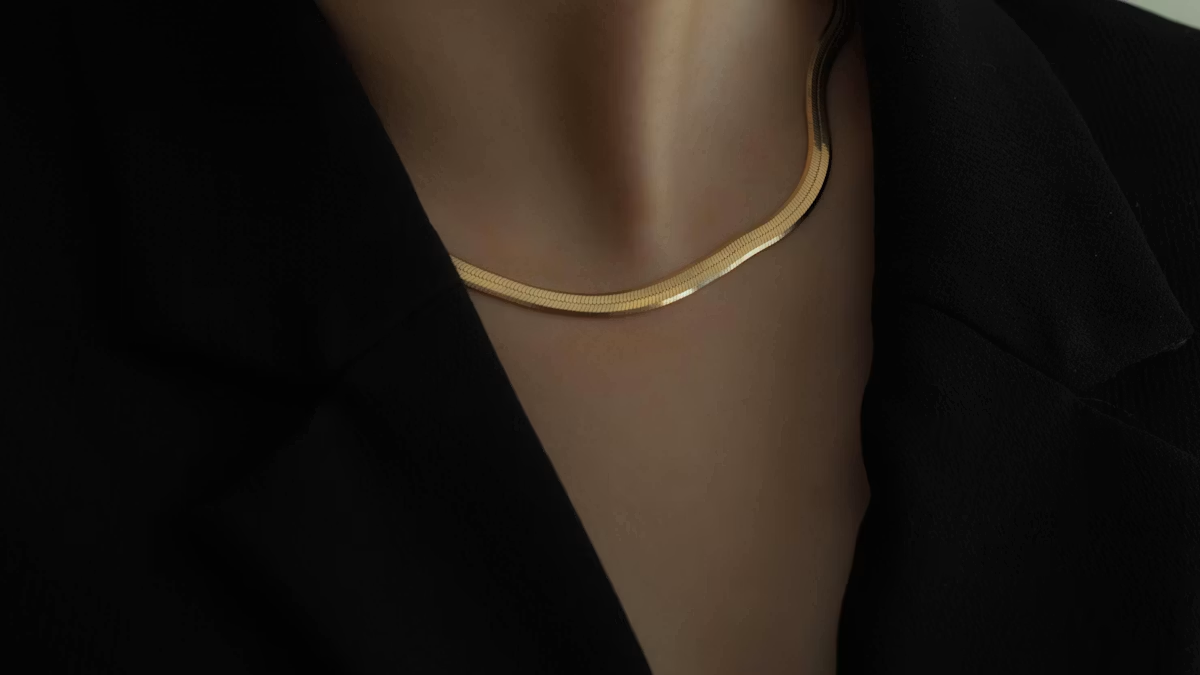
Jewelry MOQ means the minimum order quantity a supplier is willing to accept for a specific buying route, product, component, finish, packaging item, or order value. For B2B jewelry buyers, the right question is not only “what is the MOQ?” but “what exactly does that minimum apply to, and what risk does it create for the first purchase?”
If you are planning a first wholesale order, start by comparing routes: paid samples, ready-stock mixed orders, wholesale restocks, custom production, and custom development. Each route has a different balance of availability, setup work, approval steps, and cash exposure. Jewena’s current route overview is available at MOQ and pricing, and buyers can also browse wholesale jewelry options before preparing an inquiry.
What MOQ can apply to
MOQ is often discussed as one number, but in jewelry procurement it may apply at several levels. A supplier may quote a minimum per SKU, per design, per color, per finish, per size, per batch, per packaging item, or per total order value. A charm in one finish and the same charm in another finish may be treated as separate lines. A card, pouch, tag, or barcode label can also have its own minimum if it must be purchased, printed, or prepared separately.
This is why a low total order quantity does not always mean a low-risk order. A buyer might meet a total order value but still miss the required quantity for one finish, one plating batch, or one packaging component. Before payment, ask the supplier to state whether the minimum is calculated by piece count, SKU count, finish, order value, or another unit.
Compare the main first-order routes
The first decision is whether you are buying existing goods, adjusting an existing product, or developing something new. The more the order changes the product, finish, components, packaging, or approval process, the more likely a separate minimum or setup cost becomes.
| Route | Typical buyer goal | MOQ focus | Main risk to control |
|---|---|---|---|
| Paid samples | Check appearance, size, finish, and packaging direction before a larger order | Usually sample availability, sample cost, and whether the sample represents bulk production | Approving a sample that is not the same route as the future bulk order |
| Ready-stock mixed order | Test several styles with smaller quantities across a broader assortment | Whether mixed SKUs can count together and which items are actually available | Overbuying slow-moving designs or assuming all colors and sizes are in stock |
| Wholesale restock | Reorder proven styles after sell-through data | Minimums by SKU, finish, or order value | Missing replenishment timing or changing a best seller without approval |
| Custom production | Add brand presentation to existing or lightly adapted products | Logo tags, cards, pouches, labels, and packing instructions | Packaging components creating separate minimums or delays |
| Custom OEM/ODM | Develop a new design, component, finish combination, or branded collection | Design route, tooling or molds if required, components, finishes, and approvals | Starting bulk work before drawings, samples, and specifications are confirmed |
Paid samples are not the same as a bulk MOQ
A paid sample order helps a buyer inspect style direction, scale, clasp feel, stone setting appearance, logo placement, or packaging concept. It does not automatically prove that bulk production will have the same commercial terms, delivery timing, or component availability. If a sample is made from available stock but the later order requires a new finish batch, the bulk minimum may change.
Before approving samples, ask whether the sample is from current stock, a production-representative sample, or a handmade development sample. Also ask which parts of the sample approval will be locked for bulk: design, dimensions, finish, material description, packaging, labeling, and acceptable variation. Keep the approval record simple and written.
Ready-stock mixed orders and wholesale restocks
Ready-stock buying can spread a first wholesale test across several styles, such as a bold gold PVD motif chain jewelry set and smaller gold PVD 316 stainless CZ motif pendant charms. For both initial orders and restocks, confirm the current quotation, inventory, approved finish and color, packaging instructions, reorder timing, and any component change in writing; prior quantity, price, or availability may no longer apply.
Custom production and packaging minimums
Custom production orders may add logo cards, pouches, tags, barcode labels, or carton marks to existing products. Product and packaging minimums can differ, so confirm each branded element's quantity, cost, artwork approval, reordering rule, file owner, and timing. Standard packaging can reduce first-order risk until sales data supports a custom run.
Custom OEM/ODM development
Custom development is the route for new designs, adjusted dimensions, new component combinations, or a collection built around a brand brief. It can be valuable for differentiation, but it needs tighter control than a simple stock order. Jewena’s OEM and ODM jewelry service page is the right starting point for buyers preparing a development brief.
For custom work, minimums may depend on design complexity, components, finish, and approvals. Treat stainless steel or 316 as SKU-specific material descriptions, never as a collection-wide promise.
First-order planning checklist
- Choose the route first: sample, ready-stock mixed order, wholesale restock, custom production, or custom OEM/ODM.
- List quantities by SKU, design, finish, color, size, and packaging requirement instead of giving one total quantity only.
- Ask whether mixed SKUs can count toward any order threshold and which lines are excluded.
- Confirm what is in stock, what must be produced, and what still needs development or artwork approval.
- Request written terms for sample cost, bulk quotation, payment schedule, Incoterms, inspection or defect process, and change approvals.
- Keep a simple approval file with product links, photos, drawings if used, material descriptions, finish notes, packaging files, and final confirmed quantities.
How to calculate landed unit cost
MOQ only tells you the minimum buying threshold. It does not tell you whether the order is profitable after all costs. Use a landed-unit-cost view before deciding whether a low quantity, mixed order, or custom order makes sense.
Landed unit cost formula: (product cost + allocated sample or development charges + packaging + inland handling + international freight + applicable duties and taxes + payment or clearance fees) ÷ expected sellable units. Use expected sellable units—not ordered units—when the model includes a documented defect or shortage allowance; do not also add the same allowance to the numerator.
A brief hypothetical example: if a buyer spreads a one-time packaging setup across a very small first order, each unit carries a higher share of that setup. If the same packaging is used for later restocks, the allocated cost per unit may fall. The exact calculation depends on the written quotation and the buyer’s import costs.
Cash-risk controls before payment
Before payment, request an itemized quotation; record which charges are refundable, creditable, or non-refundable; approve a production-representative sample for any new finish, component, or packaging; require written approval for changes; and document how shortages, defects, substitutions, and canceled components will be handled.
Sample approval steps
- Send product links, reference photos, target market, material and finish expectations, and packaging needs.
- Ask the supplier to identify whether each item is stock, custom production, or custom development.
- Review the sample quotation and confirm what the sample does and does not represent.
- Approve or reject the sample with written notes, photos, and marked changes where needed.
- Request the final bulk quotation only after the approved route and specifications are clear.
Questions to ask before payment
- Does the MOQ apply per SKU, design, finish, color, size, packaging item, batch, or total order value?
- Can ready-stock styles be mixed, and are any SKUs excluded from the mixed order?
- Which items are available now, which require production, and which require development?
- Are samples from stock, production-representative, or handmade for review only?
- What approval is needed for logo, packaging, labels, barcodes, and carton marks?
- Which Incoterms, freight method, inspection process, and defect-handling terms are included in the quotation?
Compact inquiry template
Use this format when contacting a supplier so the reply can be specific:
Hello, we are planning a first jewelry order for [market/channel]. We are interested in [product links or reference styles] and would like to compare [sample / ready-stock mixed order / wholesale restock / custom production / OEM or ODM development]. Target quantities are [quantity by SKU, finish, color, or size]. Packaging needs are [standard / logo card / pouch / label / barcode / other]. Please confirm the MOQ basis, current availability, sample route, quotation items, Incoterms, payment terms, approval steps, and any separate packaging or development requirements. Thank you.
Final takeaway
A good jewelry MOQ discussion turns a vague minimum into a practical buying plan. Define the route, separate product and packaging requirements, confirm whether the minimum applies by SKU or another unit, and calculate landed unit cost before committing cash. For current routes, review MOQ and pricing, browse wholesale jewelry, or send a program-specific request through Jewena contact.