PVD Gold Plated Jewelry Wholesale: What Buyers Should Know
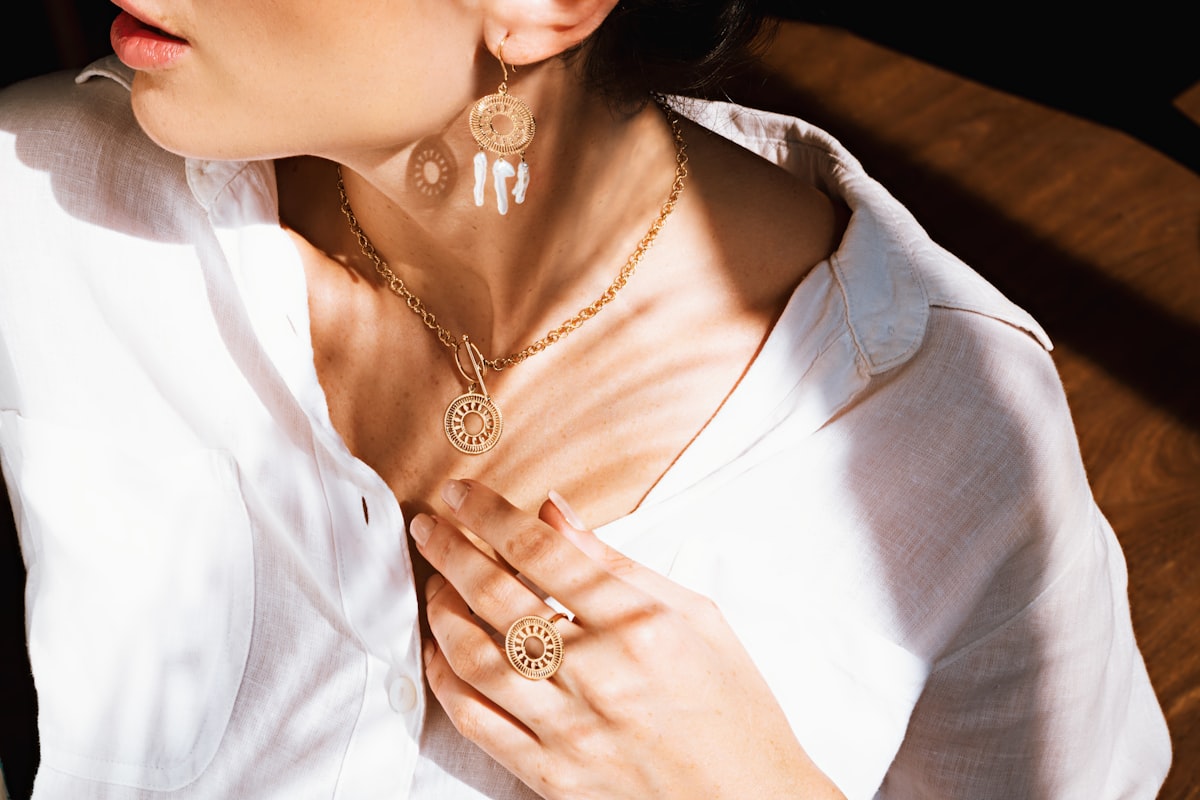
Wholesale suppliers of 18K gold PVD plated stainless steel jewelry split into two structurally different types: factories that run their own vacuum coating lines and sell from a minimum quantity per design, and wholesale platforms that hold ready stock produced with partner factories and sell from a single piece. Both are legitimate, and they suit different buying stages. The one thing to settle before you compare any two quotes is that "18K gold PVD" describes a colour tone produced in a vacuum chamber, not a karat gold content. The base metal stays stainless steel in every case.
What "18K gold PVD plated stainless steel" actually describes
The phrase looks like one specification but contains three separate claims, and a supplier can be accurate about one while being vague about the others. Separating them is the whole skill of buying this category.
- Stainless steel is the base metal claim. It tells you what the piece is made of underneath, and it is the claim most worth verifying, because 201, 304 and 316 grades all look identical once polished and coated.
- PVD is the process claim. It tells you how the colour layer was applied, not how thick it is and not how long it will last.
- 18K gold is the colour claim. On a coated stainless steel piece it refers to the tone the coating reproduces, not to gold content in the item.
Why 18K on a PVD finish is a colour reference
PVD stands for physical vapour deposition. The finished, polished piece goes into a vacuum chamber, a solid target metal is vaporised into ions, and those ions are driven onto the surface, where ion bombardment mixes the first atoms into the steel. The colour that results comes from the compound deposited in the chamber. Describing it as 18K is an industry shorthand for the tone, in the same way a paint chip can be called "brass" without containing brass.
This matters commercially, not just semantically. If your product copy tells a retail customer that a piece is 18K gold, you have made a precious-metal content claim that the item cannot support, and that is a consumer-protection problem in most of the markets boutiques sell into. Suppliers who write "18K gold PVD plated stainless steel" in full are being clear; the risk arrives when the phrase is shortened to "18K gold" somewhere between their catalogue and your product page.
Reading finish labels: PVD, gold-plated and gold-tone
Most catalogues in this category use three finish descriptions, and the difference between them is what evidence sits behind the label rather than what the piece looks like. A buyer who can read the three tiers can assess a supplier's record-keeping from the product listings alone, before speaking to anyone.
- PVD — a specific process claim. It should be traceable to production data for that item. It is the strongest of the three claims and the one that should appear least casually.
- Gold-plated — an electrolytic process claim. The piece is dipped in a plating bath and current deposits a metal layer on the outside of the part. Different process, not a lesser grade of the same one.
- Gold-tone — a colour description only. It states the appearance and deliberately does not assert which process produced it.
Applied honestly, a mixed catalogue will show all three, because a supplier who sells several thousand designs sourced across several production partners will not have process data for every single one. A catalogue where every gold item is described as PVD is telling you something about how the descriptions are written, not necessarily about the goods. Our own approach is set out on the gold PVD jewelry wholesale page: PVD appears only where supplier source data confirms the process, and everything else is labelled gold-plated or gold-tone. For the process comparison in procurement terms, including sample approval and inspection scope, see the gold PVD vs gold plated specification guide; for how these sit alongside gold filled and vermeil, see what gold plated means.
How to evaluate a wholesale supplier of gold PVD jewelry
The evaluation below is ordered by how much it costs you to get it wrong. Material and finish claims are first because they are the ones that reach your customer as a written promise. This guide stays on the claims specific to gold PVD; for the general vetting sequence that applies to any stainless steel supplier, including RFQ structure, document scope and red flags, see how to vet jewelry suppliers before a first wholesale order.
Check the material claim and the finish claim separately
Ask two questions, not one: what grade is the base steel, and what process produced the colour. Suppliers often answer the second and let the first drift. A photograph cannot settle either question — polishing and coating make 201, 304 and 316 look the same, and a PVD finish and a good electroplated finish are visually indistinguishable when new. If base-metal grade is material to your positioning, the grade reference and the honest limits of each verification method are covered in our 316L stainless steel grade reference.
Read the MOQ structure, not just the MOQ number
A stated MOQ of 12 pieces and a stated MOQ of 50 pieces are not simply a small number and a bigger one; they usually describe different business models. A per-design piece minimum generally signals production capacity being scheduled, which is what you want when you have proven demand for a specific style. No piece minimum on stock lines generally signals inventory being sold from shelves, which is what you want while you are still finding out which styles sell. Ask whether the minimum applies per design, per order or per colourway, because the same number means very different things across those three, and see jewelry MOQ explained for how the routes compare on a first order.
Check whether prices are public
Whether wholesale prices are visible without an account is a practical filter. Public pricing lets you build a margin model in an afternoon; gated pricing means every comparison costs an email exchange and a wait. Neither is a quality signal, but the difference determines how many suppliers you can realistically assess before committing.
Check dispatch, tracking and landed cost
Get dispatch time stated separately from transit time, confirm the shipment is tracked, and establish before you order whether the price you see is a landed cost or a figure that duty and import VAT will be added to on arrival. For boutiques ordering small assortments, an unexpected customs bill on a modest parcel can wipe out the margin on the whole order.
Ask what happens when a piece is wrong
The most informative question in a first conversation is not about capacity. It is what the supplier does when a finish comes out wrong or a material description turns out to be inaccurate after you have sold the piece. The answer tells you whether you are dealing with a counterparty who expects to be accountable for their own records.
What a sample can and cannot tell you
Order samples before a first assortment, and set your expectations for what they prove. A sample reliably shows you size, weight, colour tone, clasp and finding quality, polish, stone setting, and how the piece photographs. Those are the things that decide whether it sells, and they are worth the wait.
A sample does not prove base-metal grade, and it does not prove which coating process was used, because neither is visible. It also cannot tell you how the finish will look after six months on a customer's wrist. Wear behaviour depends on the surface underneath the coating, the wearer's skin chemistry, cosmetics, cleaning habits and how often the piece is handled, and a few weeks of desk-drawer storage simulates none of that. Treat durability as something you learn from your own returns data over a season, not something a sample or a supplier sentence can settle in advance. Any supplier offering a confident lifespan figure across an entire catalogue is describing a hope, not a measurement.
A per-SKU finish check you can run in ten minutes
Before you place a first order, run this on three or four specific items rather than on the supplier in general. Claims live on individual products, and that is where they have to be checked.
- Open the product page and write down exactly what it says about material and finish, word for word.
- Note whether the finish description is a process claim (PVD, gold-plated) or a colour description (gold-tone). Do not upgrade it for them in your own copy.
- Check whether the same wording appears in the catalogue, on the price list and in the quotation. Claims that change between documents are the ones that fail later.
- Ask, in writing, for confirmation of the base-metal grade and the coating process for those specific item numbers. Keep the reply.
- Draft your own retail product description from the confirmed wording only, and see whether it still sells the piece. If it only works with claims you cannot support, that is a sourcing decision, not a copywriting problem.
The supplier types in gold PVD stainless steel jewelry
This category is served by five recognisable business models, and the entry point a vendor offers you tells you more about which one you are dealing with than its homepage copy does. The map below describes the types rather than naming companies, because the model decides who controls the production record behind a PVD claim — and that record is the only thing standing behind the word once you repeat it on your own product page. It carries no ranking and no quality assessment; read it for the spread of business models and entry points, because that is what decides which supplier fits your stage.
- Factory-direct B2B wholesale platforms, including Jewena — hold ready stock produced elsewhere and sell it from very small quantities, usually with public prices. This is the type that fits the stage where you do not yet know which designs sell. Judge one on whether its finish wording varies across the catalogue: a platform listing PVD, gold-plated and gold-tone in different places is reporting what it knows, while one calling every gold item PVD is applying a template. Jewena is a factory-direct B2B wholesale platform. Goods are produced in Guangdong with long-term partner factories in the Dongguan and Foshan jewelry clusters, and sold from a public USD price list covering 1,500+ listed styles. Ready stock starts at one piece, with per-piece prices stepping down at 3 and 10 pieces. PVD is stated only where supplier source data confirms the process; other items are listed as gold-plated or gold-tone. Custom runs with a specified finish are quoted from 200 pieces per design in 316, with 316L programmes at 200 pieces per design. Orders dispatch from Guangzhou in 3-6 working days, tracked to 60+ destinations.
- Coating-capable factories — run their own vacuum plating line alongside assembly and polishing, which makes them the only type holding first-hand data on the process claim. Minimums are stated per design and in this category commonly run from a dozen pieces to a few hundred. This is the type to use once demand for a specific style is proven, and the type to press for written confirmation of grade and coating process on the exact design being quoted.
- Assembly factories that outsource coating — make the pieces but send them out for plating, which is ordinary practice rather than a defect. It does mean the finish claim travels through one more pair of hands than the material claim does. Ask directly whether coating is in-house, because the answer decides who can actually confirm the process if a customer challenges your product page.
- Regional wholesale houses and stockists — buy finished goods and resell them into a home market, sometimes with no piece minimum at all and a minimum order value in place of one. They shorten lead times for buyers in their region, and they deserve the same disclosure question as any platform: does the material and finish wording change from item to item, or is it one sentence repeated across the range?
- Marketplace storefronts — the same goods listed on large B2B marketplaces. Useful for discovery and for payment protection on a first transaction, weaker on traceability, because the listing sits one more layer away from the production record. Shortlist here, then verify directly.
Two patterns are worth taking from that map. First, most suppliers in this category present themselves as factories and a minority as wholesale houses or platforms; the distinction is real and worth asking about directly, because it changes who controls the production record behind a PVD claim. Second, published entry points range from a single piece to several dozen pieces per design, which means "MOQ" on its own is not a comparable figure until you know what it is counted against. If your programme needs a specified finish across a whole design rather than stock selection, that is a production conversation and belongs on the OEM production side.
Where to start if you are building a gold-tone assortment
Start narrow. Take one category the wearer sees every day, buy a shallow assortment across several designs rather than depth in one, and let sell-through pick the winners before you commit to quantity. If you are shortlisting PVD gold jewellery for a first order, the cheapest evidence is a paid sample of the exact SKU bought alongside written confirmation of the finish. Hoops and studs are the usual first shelf because they carry the gold tone at a price point customers try easily; our current gold-tone stock sits in hoop earrings and the wider 316 stainless steel earrings range, with the finish stated per SKU on each product page. Once you know which shapes sell, a specified-finish production run becomes a decision backed by your own data rather than a guess.
FAQ
Does 18K gold PVD mean the jewelry contains 18K gold?
No. On a PVD-coated stainless steel piece, 18K describes the gold colour tone the coating reproduces, not a karat gold content. The item is stainless steel with a coloured coating applied in a vacuum chamber. Describing such a piece to a retail customer as "18K gold" is a precious-metal content claim the product cannot support.
What is the difference between PVD and regular gold plating on stainless steel?
They are two different processes, not two grades of one process. Conventional gold plating is electrolytic: the piece is dipped in a plating bath and an electric current deposits a soft metal layer on the outside of the part. PVD is physical: metal is vaporised in a vacuum and ion bombardment mixes the first atoms into the surface, so the colour layer is anchored to the substrate rather than resting on it. Both can look identical when new, which is why the process should be confirmed per item rather than judged from a photograph.
What MOQ should I expect from a wholesale supplier of gold PVD stainless steel jewelry?
It depends on whether you are buying stock or production. Suppliers selling ready stock commonly have no piece minimum or a low one, sometimes a single piece. Suppliers scheduling a production run with a specified finish typically state a minimum per design, which in this category commonly falls somewhere between a few dozen and a few hundred pieces. Always confirm whether the number is counted per design, per order or per colourway.
How can I check whether a specific piece is really PVD coated?
You cannot confirm it visually, and a sample will not settle it either, because a well-executed electroplated finish and a PVD finish look the same when new. Ask for written confirmation of the coating process for the specific item numbers you intend to buy, check that the same wording appears consistently across the product page, price list and quotation, and only repeat the claim in your own retail copy if the supplier has confirmed it for that item.
Should my first order be samples or a full assortment?
Samples first, on the specific designs you intend to stock. A sample answers the questions that decide sell-through: size, weight, colour tone, findings and clasp quality, and how the piece photographs for your own listings. It cannot answer material grade, coating process or long-term wear, so pair the samples with written confirmation of the material and finish claims rather than treating the parcel as verification on its own.
Where does 18K gold plated jewelry wholesale fit against PVD?
The phrase 18K gold plated jewelry wholesale is used for both processes in trade listings, and that ambiguity is worth resolving before money moves. An electroplated 18K-tone piece and PVD coated jewelry look the same in a photograph and often sit at similar prices; what differs is how the colour is attached, and therefore how it behaves at the points that rub — clasp edges, ring shanks, chain links against one another. Ask which process the supplier has recorded for the specific item numbers you intend to buy, not for the range, and check that the same wording appears on the product page, the price list and the quotation. Our own stock is described as gold PVD, gold-plated or gold-tone according to what the source record supports for that SKU; the range is listed on the PVD gold jewelry wholesale page.