Men's Stainless Steel Jewelry & Chain Wholesale: Cuban, Figaro, Franco
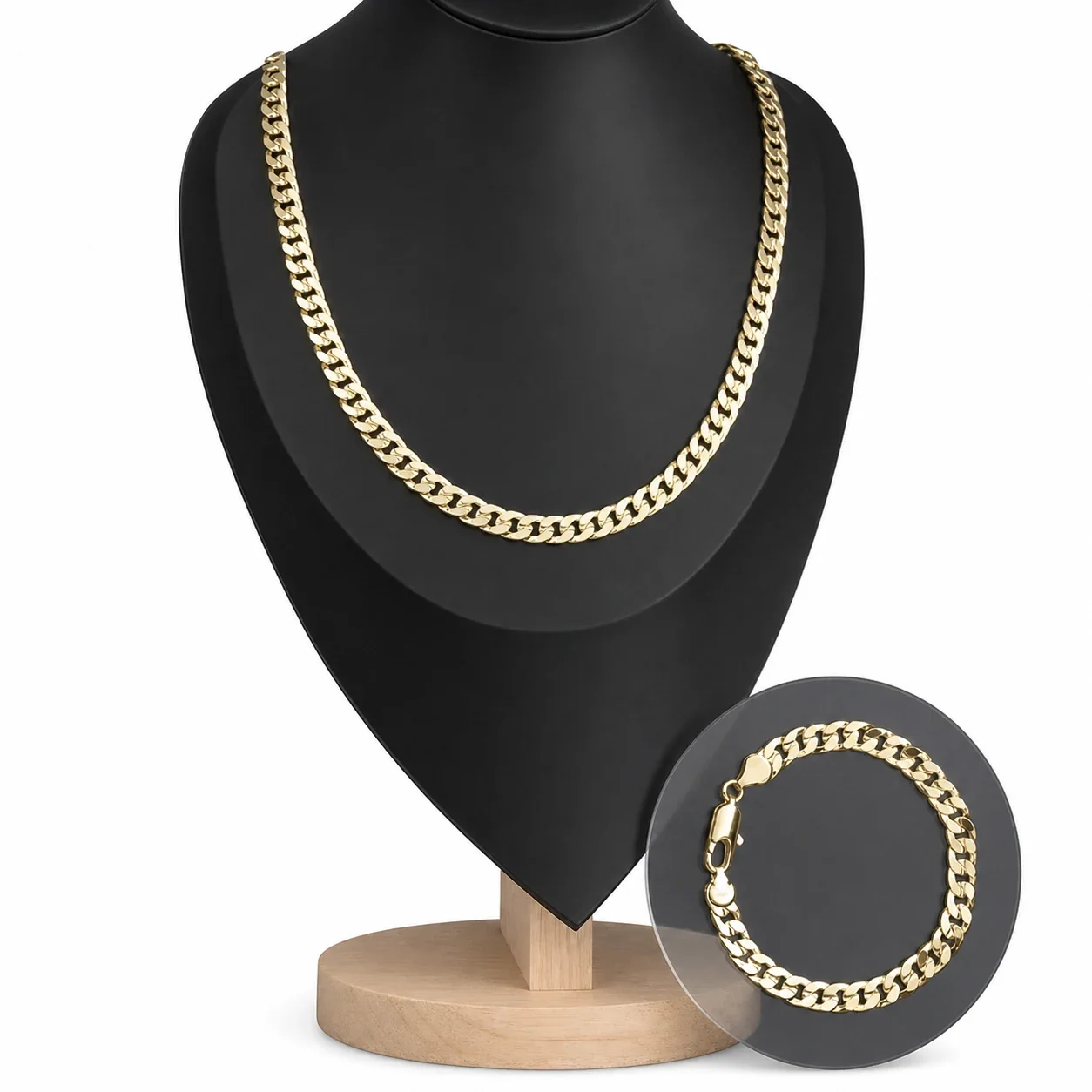
Wholesale suppliers for men's stainless steel jewelry fall into four practical types, and a streetwear shop should know which one it is buying from. Men's and hip-hop vertical specialists build their whole catalogue around chains and carry the deepest width and length coverage. General wholesale jewelry distributors carry steel as one line among many materials and usually set a per-order value minimum. Vertically integrated factories produce chains in-house and quote by production run. Factory-direct B2B platforms publish per-piece wholesale prices online and ship ready stock. Jewena is the fourth type: a factory-direct wholesale platform selling ready-stock men's stainless steel jewelry produced in Guangdong with long-term partner factories in the Dongguan and Foshan jewelry clusters, with 47 Cuban link listings, 28 curb chains and 40 signet rings live and no minimum order. Which type suits you depends on stage rather than price, and the supplier type map further down sets out what each one is good for.
What a Streetwear Shop Actually Needs From a Men's Jewelry Supplier
Men's steel is a different buying problem from women's fashion jewelry. The assortment is narrow — chains, ID bracelets, signet rings, studs — but each style sells across a wide range of widths and lengths, and the same design in 6mm and 12mm reaches two different customers. A supplier that suits a streetwear shop therefore has to solve three things at once: enough width and length variation to build a wall display, low enough entry quantities that a new width can be tested before it is bought deep, and material descriptions specific enough that staff can answer a customer asking what the chain is made of.
That last point is where most sourcing goes wrong. Men's chains are the category where plated brass, unspecified stainless steel and 316-grade stainless steel all look identical in a product photo, and where the word "iced" is used for everything from crystal-set pendants to fine jewelry. A buyer who cannot tell those apart on the supplier's own listing will not be able to answer returns questions later.
Chain Types Explained: Cuban, Curb, Figaro, Franco, Paperclip, Rope and Box
Chain type is the single biggest driver of how a men's piece reads on the body and what it can be priced at. The five that carry most men's steel assortments are below, with what each one is actually doing.
- Cuban link: flattened, interlocking oval links that lie flat against the skin. The reference men's chain and the backbone of hip-hop and streetwear display. Reads heavy at any width and carries pendants well. Our own catalogue is weighted here — 47 published Cuban link listings, the largest single family.
- Curb: the same twisted-and-flattened link principle as Cuban but with a lighter, more open profile. Sells to the customer who wants the shape without the mass, and works better under a collar. 28 published listings.
- Box: square links joined end to end, producing a clean geometric line. Quieter than Cuban or curb, so it does the work in minimal and layering-oriented displays, and it holds a single pendant without competing with it. 37 published listings.
- Rope: multiple strands twisted into a spiral, which catches light along its whole length. Reads dressier than Cuban at the same width. 11 published listings, so it is a supporting style in our range rather than a core one.
- Figaro: a repeating pattern of short links broken up by one longer link. Recognisable at a glance and traditionally strong in Southern European and Latin American markets. 5 published listings.
- Franco: dense, V-shaped links packed so tightly that the chain reads as a rounded, solid rope of metal. Heavier-looking than curb at the same width, stiff enough to hold a large pendant upright, and bought almost entirely by men.
- Paperclip: long, open oval links with a light, modern profile. Mostly a women's and unisex style, but thin paperclip chains also sell to men as a layering piece next to a Cuban.
Two more are worth knowing because customers ask for them by name: herringbone (flat, ribbon-like, high shine, and the most easily kinked of the group) and snake (smooth, rounded, tight-linked). We hold 9 and 30 published listings respectively. A first men's display does not need all nine — Cuban and curb plus one quieter option covers most of the demand.
The full ready-stock range sits in men's jewelry, broken down into men's necklaces, men's bracelets, men's rings and men's earrings, with the chain families themselves under chains.
How to Read Width, Length and Weight
Width in millimetres is the specification that decides who buys the piece, and it is the one most often missing from wholesale listings. As a rough guide for men's steel: 3–6mm reads as everyday and layers under clothing, 8–12mm is the standard streetwear statement width, and anything above 12mm is display-driven — it sells slowly but anchors a wall. Length follows the same logic: 45–50cm sits at the collarbone, 55–60cm falls onto the chest and is the usual choice for a pendant.
Ask for gram weight alongside width, because the two together are what separate a solid chain from a hollow one. Two chains quoted at the same width and length can differ substantially in weight, and the lighter one will feel wrong to a customer who has handled the heavier version elsewhere. Weight is also the honest predictor of your shipping cost per piece, which matters more on men's chains than on any other jewelry category.
Where our source specifications support it, width is stated on the listing itself — a 10mm Cuban link chain necklace and a 14mm iced Cuban link bracelet are both live examples. Where a listing does not state a width, treat that as a question for the supplier rather than an assumption.
How to Check Material and Finish Claims
This is the section to read twice. A product photograph can prove shape and colour. It can never prove what the metal is, how the colour was applied, or what the stones are. Every material question has to be answered from the listing text or from the supplier in writing.
Steel base versus plated brass
Stainless steel and plated brass are both common in men's chains and they behave differently over time. Stainless steel is a solid alloy throughout, so a scratch exposes more of the same metal. Plated brass is a base metal carrying a surface layer, so wear-through eventually exposes the brass underneath, which is what customers describe as a chain "turning". Neither is inherently the wrong choice, but they are not interchangeable and should not be sold as if they were. Ask which one you are buying, per SKU, and expect a straight answer.
Grade claims: 316, 316L and unlabelled steel
316 and 316L are specific stainless steel grades containing molybdenum, which improves resistance to pitting corrosion compared with grades that lack it. A supplier writing "316L" on a listing is making a grade claim, not supplying proof — and grades cannot be distinguished by eye after polishing or coating. Our own practice is to state the grade only where the source specification supports it: across the six families counted here — Cuban, curb, box and rope chains, Figaro links and signet rings —, 64 published listings state 316 and 8 state 316L, while the rest are described simply as stainless steel with no grade claimed. If a supplier's entire men's catalogue claims 316L without variation, that is worth a question rather than reassurance. For the underlying material detail, see our references on 316L versus 304 stainless steel and what 316L means on jewelry.
Gold colour: plating and PVD
Gold-tone men's chains reach that colour by one of two routes. Electroplating deposits a surface layer electrochemically. PVD — physical vapour deposition — applies the colour in a vacuum chamber, producing a coating bonded to the substrate rather than sitting on it as a separate electrodeposited layer. The practical buying rule is that the process should be declared per SKU, in writing, and that "gold" on a steel chain means a colour treatment, not gold content. Our fuller explanation is in gold PVD versus gold plated.
Iced pieces and what the stones are
"Iced" describes an appearance, not a material. On stainless steel men's jewelry at wholesale prices the stones are cubic zirconia or crystal, and they should be described that way on the listing. We do not describe them as diamonds, and a supplier who does at these price points is telling you something useful about the rest of their descriptions. Construction also varies within a single iced piece: one of our own listings is described as a stainless steel chain with an alloy pendant, which is exactly the kind of detail that has to appear on the product page rather than in a conversation after the order arrives.
How to Read MOQ and Tier Pricing
Minimum order rules are the clearest signal of what a supplier is set up to do, and they come in three shapes. A per-style production minimum means the supplier is quoting factory runs. A per-order value minimum means the supplier is a distributor with picking and handling costs to cover. No minimum at all means the supplier holds ready stock and is set up to ship single pieces.
None of these is better in the abstract — they suit different stages. A shop opening its first men's display needs to test which widths sell, and a per-style minimum makes that test expensive. A shop that already knows its bestsellers gets better unit economics from a production run. Read the minimum as a description of the supplier's business model, then match it to which of those two situations you are in. Our own structure has no minimum on ready stock, with unit prices stepping down automatically at 3 and 10 pieces per SKU, and written quotes for volume on a single style. Custom production is a separate track: OEM starts at 200 pieces per style in 316 or 316L. A fuller walkthrough is in our guide to jewelry MOQ and the first wholesale order.
Building a First Men's Order for a Streetwear Shop
The practical approach for a first order is breadth over depth, because you are buying information as much as inventory. A workable shape:
- Take one piece of many styles, not many pieces of few. Where a supplier allows single-piece ordering, a first order should cover the Cuban and curb widths you are unsure about plus a few signet rings and ID bracelets, rather than committing to one width across a quantity.
- Cover the width spread deliberately. One narrow, one mid, one wide in your lead chain type tells you more in three weeks of trading than any amount of pre-purchase research.
- Handle everything before it goes on the wall. Check clasp action, weight against the stated width, plating evenness at the links, and how the chain lies when worn rather than flat on a tray.
- Reorder into the tiers. Once trading data shows which two or three SKUs are moving, that is the point to buy at the 3 and 10-piece steps or request a volume quote — not before.
- Keep the material note with the stock. Record what the listing said about grade, plating process and stones for each SKU you take. That record is what your staff answer customer questions from, and what you check a reorder against.
Across published Cuban link listings, per-piece wholesale prices run from about $1 to about $32 depending on width, length and finish, which means a broad first display is generally a low-cost test rather than a committed position. The category overview for retailers sits on our men's stainless steel jewelry wholesale page.
Supplier Type Map for Men's Steel
Men's stainless steel jewelry is sold by four recognisable types of supplier, and the type predicts the minimum order, the price transparency and the depth of chain sizing better than any company name does. Work out which type you are dealing with in the first exchange, then apply the checks for that type. We name only ourselves below, because another supplier's self-description is not evidence you can act on, whereas the type-level checks are.
Men's and hip-hop vertical specialists
The whole catalogue is built around chains, iced pieces, pendants and rings for a male customer. This is where the deepest width and length coverage lives, where new streetwear shapes appear first, and where OEM, ODM and dropshipping are commonly offered alongside wholesale. The trade-off is category concentration: if you also want women's lines or a broader accessory mix, you will be running a second supplier for them.
How to evaluate one: "No MOQ" is a common headline in this type, so establish what it actually applies to, whether ready stock, custom work or only part of the range, and get the answer in writing. Ask for gram weight alongside width, because a specialist who cannot give weight per size is reselling rather than producing. Check whether grade claims vary across the catalogue, since a men's range where every single listing claims 316L is making a marketing statement rather than a specification. Ask what "iced" means on their listings item by item. Best fit: a shop whose men's wall is the main business.
General wholesale jewelry distributors
Carry many materials, typically sterling silver, plated brass and gold-tone fashion lines and sometimes fine jewelry, with stainless steel as one line among them, and often ship from a warehouse inside your own market. Delivery is fast and the paperwork is domestic, which is a real advantage. You pay a distribution margin over factory pricing for it, and men's steel is rarely the deepest part of the range.
How to evaluate one: the minimum here is usually a per-order value rather than a per-style quantity, so check whether mixed styles count towards it and whether it applies to every order or only the first. Ask how many widths they actually stock in your lead chain type, because breadth of catalogue often hides thin sizing inside any one family. Confirm whether they hold the stock themselves or drop-ship it from elsewhere, since that decides your real dispatch time rather than the one on the website. Best fit: reorders where speed matters more than unit cost.
Vertically integrated factories
Produce in-house and quote production runs, sometimes covering several stages including stone setting and plating. This is the strongest option for custom production, custom moulds and one style bought deep, and normally the lowest unit cost once you are large enough to be worth quoting for. It is a poor fit for a first display, because a per-style minimum makes testing widths expensive.
How to evaluate one: ask which stages are genuinely in-house and which are subcontracted, plating above all. Ask for the per-style minimum separately for existing designs and for custom moulds, and ask what a mould costs and who owns it afterwards. Ask for lead time in production days measured from approved sample, not from payment. Best fit: a brand ordering its own designs.
Factory-direct B2B wholesale platforms
Publish a catalogue with per-piece wholesale prices online and ship ready stock rather than production runs. Verification moves almost entirely onto the product, since the counterparty, the price and the shipping route are fixed and visible before you enquire. The range is narrower than a marketplace, and this type cannot make a design you bring yourself.
How to evaluate one: check that prices are visible without an account, that freight is quoted against your actual basket rather than as a flat figure, and that grade and plating are declared per SKU rather than asserted once across the site. Ask whether production is owned or run with partner factories. Best fit: opening a first men's display, testing widths, and mixed restocks.
Where Jewena sits
Jewena is that fourth type: a factory-direct B2B wholesale platform selling stainless steel jewelry online, produced in Guangdong with long-term partner factories in the Dongguan and Foshan jewelry clusters. The catalogue, pricing, order handling and export are ours, while production and finishing run on our own dedicated lines with long-term partner factories. Over 1,500 live styles carry wholesale prices published in USD, of which 269 published pieces sit in men's jewelry. Ready stock has no minimum order, unit prices step down at 3 and 10 pieces per SKU, and orders ship from Guangzhou in 3–6 working days with tracking to 60+ destinations. OEM production starts at 200 pieces per style in 316 or 316L. Grade is stated per SKU where the source specification supports it rather than claimed across the range, and we do not hold US, UK or EU local stock.
The useful comparison across these four is not price but model, because each one is optimised for a different stage. A buyer opening a first men's display and a brand ordering a custom-production run should end up at different types, and a shop that has traded a men's wall for a couple of years often uses two at once: a platform for testing and restocking, a factory for the two or three SKUs that have earned a production run. Whichever type you are evaluating, our checklist for vetting a stainless steel jewelry supplier covers the questions worth asking in writing.
When to Stock: What Search Demand Says About the Season
Search data is the earliest public signal of what shoppers are about to buy. Google Keyword Planner estimates for the United States show men's stainless steel searches running well above last year through the summer of 2026, with chain names that were niche a year earlier now drawing thousands of searches a month.
| US search term | July–August 2026, per month | July–August 2025, per month |
|---|---|---|
| men's stainless steel bracelets | about 12,350 | about 6,750 |
| stainless steel jewelry for men | about 3,600 | about 1,750 |
| stainless steel cuban link chain | about 3,650 | about 1,450 |
| stainless steel figaro chain | about 3,350 | about 320 |
| stainless steel paperclip necklace | about 1,040 | about 155 |
| stainless steel franco chain | about 880 | about 125 |
The seasonal shape matters as much as the level. Last season, searches for men's stainless steel bracelets rose from about 5,400 a month in November to about 14,800 in January and February, rather than peaking before Christmas. A shop that opens a men's rail in October has time to see which widths and chain types sell, and to reorder those in depth before that curve turns up. Keyword Planner figures are rounded estimates, so read them as direction and scale, not as exact counts.
FAQ
When should a shop buy men's chains for the holiday season?
Earlier than most buyers expect. US searches for men's stainless steel bracelets were already about 12,350 a month in July and August 2026, and last season they kept rising into January and February. Opening a rail in October leaves time to test widths and chain types and reorder the ones that sell before the peak.
Which chain type should a streetwear shop stock first?
Cuban link, in two or three widths. It is the reference men's chain, it carries pendants well, and it is the style customers ask for by name. Curb is the natural second, giving a lighter profile at a similar look, with one quieter option such as box chain to serve minimal and layering customers. Rope and Figaro are better added once trading data shows demand rather than bought into a first display.
Do wholesale suppliers of men's stainless steel jewelry require a minimum order?
It varies by business model, and the minimum tells you which model you are dealing with. Factories usually set a per-style production minimum, distributors often set a per-order value minimum, and platforms holding ready stock may have none. Jewena has no minimum on ready stock, with unit prices stepping down at 3 and 10 pieces per SKU; custom OEM production starts at 200 pieces per style in 316 or 316L.
Is men's stainless steel jewelry always 316 or 316L?
No, and any supplier claiming a single grade across an entire catalogue is worth questioning. 316 and 316L are specific grades, and other stainless steel grades are widely used in jewelry. Grade cannot be identified from a photograph or after polishing and coating. Read the grade claim per SKU on the listing, and treat it as a supplier statement rather than a certificate unless documentation is provided for that specific item or order.
Are iced-out Cuban chains set with real diamonds?
Not at wholesale stainless steel price points. The stones on iced steel jewelry are cubic zirconia or crystal, and a supplier should describe them that way on the product page. Construction can also be mixed within one piece — a steel chain with an alloy pendant, for example — so read the material description for the whole item, not just the headline.
How long does a first men's wholesale order take to arrive?
For ready stock ordered from Jewena, orders ship from Guangzhou within 3–6 working days with tracking, to 60+ destinations; transit time then depends on the destination and the shipping method chosen at checkout, where real rates are quoted. Custom OEM production runs on a separate and longer timeline. We do not operate US, UK or EU local stock, so a first order should be planned around international transit rather than domestic delivery times.